

02 Jul Why Does My Yard Flood Every Time It Rains? A Tulsa Homeowner’s Guide
Why Your Yard Floods in Tulsa, OK
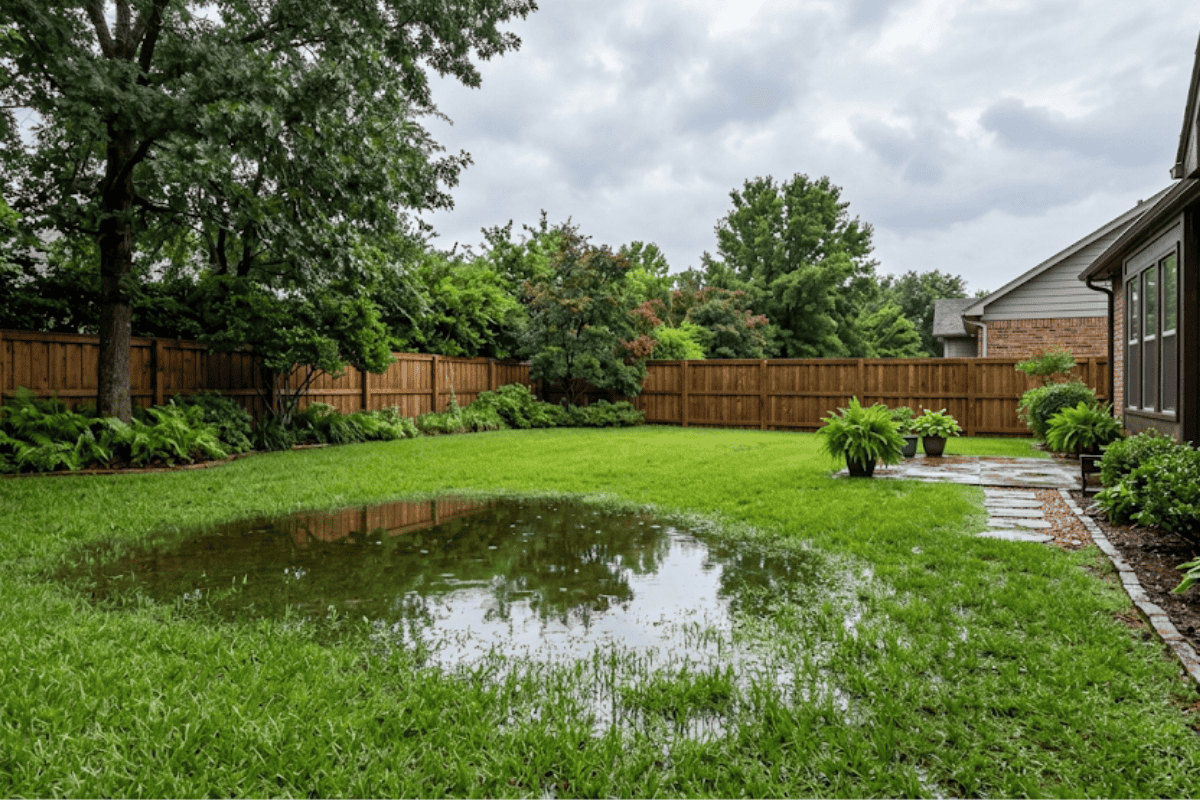
If you have ever stood at your window during a storm and wondered, why does my yard flood every time it rains, you are far from alone. Across Tulsa, Oklahoma, homeowners watch the same low spots turn into shallow ponds the moment the sky opens up. Standing water is more than an eyesore. It drowns grass, breeds mosquitoes, and can quietly work its way toward your foundation. The good news is that a soggy yard is almost always fixable once you understand what is actually happening beneath the surface, and once you have the right plan to move that water where it belongs.
The Real Reasons Water Refuses to Leave Your Yard
Most yard flooding traces back to a handful of predictable causes. The most common is poor grading, where the land slopes toward your home instead of away from it, funneling every rainfall into the same tired low spots. Compacted soil is another frequent culprit, because foot traffic, heavy equipment, and years of settling squeeze the air pockets out of the ground so water cannot soak in.
Roof runoff plays a bigger role than most people expect. When downspouts dump water right next to the house instead of carrying it several feet out, that concentrated flow overwhelms nearby soil in seconds. A high water table, buried debris, and even a neighbor’s higher lot can all send extra water your way. Because these causes often stack on top of one another, a thorough drainage evaluation is usually the smartest first step toward a permanent fix.
Why Does My Yard Flood Every Time It Rains in Tulsa?
Tulsa’s heavy clay soil is a big part of the answer for local homeowners. Clay holds together tightly and drains slowly, so water that would disappear into sandy ground instead sits on the surface for hours. The science backs this up. Clay’s naturally low infiltration rate means the ground simply cannot accept water as fast as a strong storm delivers it.
Then there is the sheer volume of rain. In 2025 alone, Tulsa recorded 54.51 inches of rainfall, much of it arriving in intense spring and early summer downpours. When a yard built on tight clay meets that kind of concentrated moisture, pooling is almost inevitable without a proper system to guide the water away. That combination is exactly why so many Broken Arrow and Tulsa, Oklahoma homes struggle with the same wet corners season after season.
Drainage Solutions That Actually Work
There is no single fix for every yard, which is why an honest assessment matters so much. Regrading and sloping the land to guide water away from your home is often the first move, and it typically runs $500 to $3,000. When the problem lives underground, a French drain, priced around $1,500 to $6,000, intercepts water and carries it to a safe outlet. A dry well, at roughly $1,500 to $5,000, collects that water and lets it seep slowly back into the ground.
For hard surfaces like driveways and patios, a channel or trench drain at $800 to $3,500 captures water before it spreads across the lawn. Simpler still, downspout extensions cost just $150 to $800 and move roof water safely away from the foundation. Finally, a catch basin and storm drain system, generally $1,000 to $4,000, gathers pooling water and pipes it off the property entirely. Planting rain gardens and reducing hard surfaces also help your soil absorb runoff more naturally over time.
| Drainage Solution | What It Does | Typical Cost Range |
| Regrading and sloping | Guides surface water away from the home | $500 to $3,000 |
| French drain | Intercepts underground water and moves it to an outlet | $1,500 to $6,000 |
| Dry well | Collects water and releases it slowly underground | $1,500 to $5,000 |
| Channel or trench drain | Captures runoff on driveways and patios | $800 to $3,500 |
| Downspout extensions | Carries roof water away from the foundation | $150 to $800 |
| Catch basin and storm drain | Gathers pooling water and pipes it off the property | $1,000 to $4,000 |
If the puddles keep coming back no matter what you try, call Elite Outdoor Services for a professional assessment and a clear, honest quote.
Warning Signs You Should Not Ignore
A little water after a big storm is normal, but some signals mean it is time to act quickly. Watch for these red flags:
- Standing water that lingers for more than 24 hours after the rain stops
- Soggy, spongy patches of lawn that never fully dry out
- Water pooling against the foundation, siding, or a crawl space vent
- Persistent mildew smells, mosquitoes, or dying grass in the same spots
- Cracks in walkways or a slab that seems to be shifting or settling
Any one of these is worth a closer look before a small nuisance becomes an expensive repair.
Why Choose Elite Outdoor Services
With more than 20 years of experience serving Tulsa, Oklahoma and the surrounding communities, Elite Outdoor Services has solved drainage problems on every kind of lot. Homeowners across Broken Arrow, Bixby, Jenks, Owasso, and Glenpool trust our team because we diagnose the true cause rather than guessing at a quick patch. Here is what sets us apart:
- Two decades of hands-on experience with local clay soil and grading
- Complete solutions, from drainage and irrigation to hardscape and landscape lighting
- Custom systems designed for your specific slope, soil, and rainfall
- Clear communication and honest pricing with no surprise upsells
- Reliable local crews who stand behind their workmanship
Conclusion
A flooded yard can feel like a problem you simply have to live with, but it rarely is. Once you understand why water pools where it does, whether from poor grading, compacted clay, or misdirected downspouts, the path to a dry, healthy lawn becomes clear. The right combination of regrading, drains, and smart landscaping can transform even the wettest corner of your property. If you are tired of watching your yard turn into a pond every storm, reach out to Elite Outdoor Services and let our experienced team design a lasting solution built for Tulsa conditions.
Ready to stop the flooding for good? Schedule your free consultation with Elite Outdoor Services today.
Frequently Asked Questions
Why do I have standing water in my yard?
Standing water usually means the ground cannot absorb or drain rainfall fast enough. Common causes include compacted or clay-heavy soil, a low spot that collects water, or land that slopes toward the area instead of away. Poorly directed downspouts and a high water table can also leave water sitting for hours or even days.
How do I fix a yard that floods?
Start by determining whether the water sits on the surface or is trapped underground. Surface problems are often solved by regrading the yard, while subsurface water usually calls for a French drain, dry well, or catch basin. For lasting results, a professional evaluation of your soil and slope is the most reliable path.
Why does my yard flood but my neighbor’s doesn’t?
Differences between neighboring yards often come down to grading, soil type, and elevation. Your lot may sit lower, have more compacted soil, or slope in a way that channels water toward your home. Nearby construction, added pavement, or an altered drainage path can also send extra water in your direction.
How long should it take for standing water to drain?
In a healthy yard, water should drain within about 24 hours after the rain stops. If puddles linger for more than a day or two, it usually points to compacted soil, poor grading, or a high water table. Water that stays for several days can damage your lawn and should be addressed.
Can yard flooding damage my home’s foundation?
Yes. Water that repeatedly pools near your home can seep toward the foundation, leading to cracks, settling, and crawl space or basement moisture over time. Keeping water moving away from the structure is one of the most important reasons to fix persistent yard flooding.

Sorry, the comment form is closed at this time.