

07 Aug Signs You Need a French Drain in Your Yard
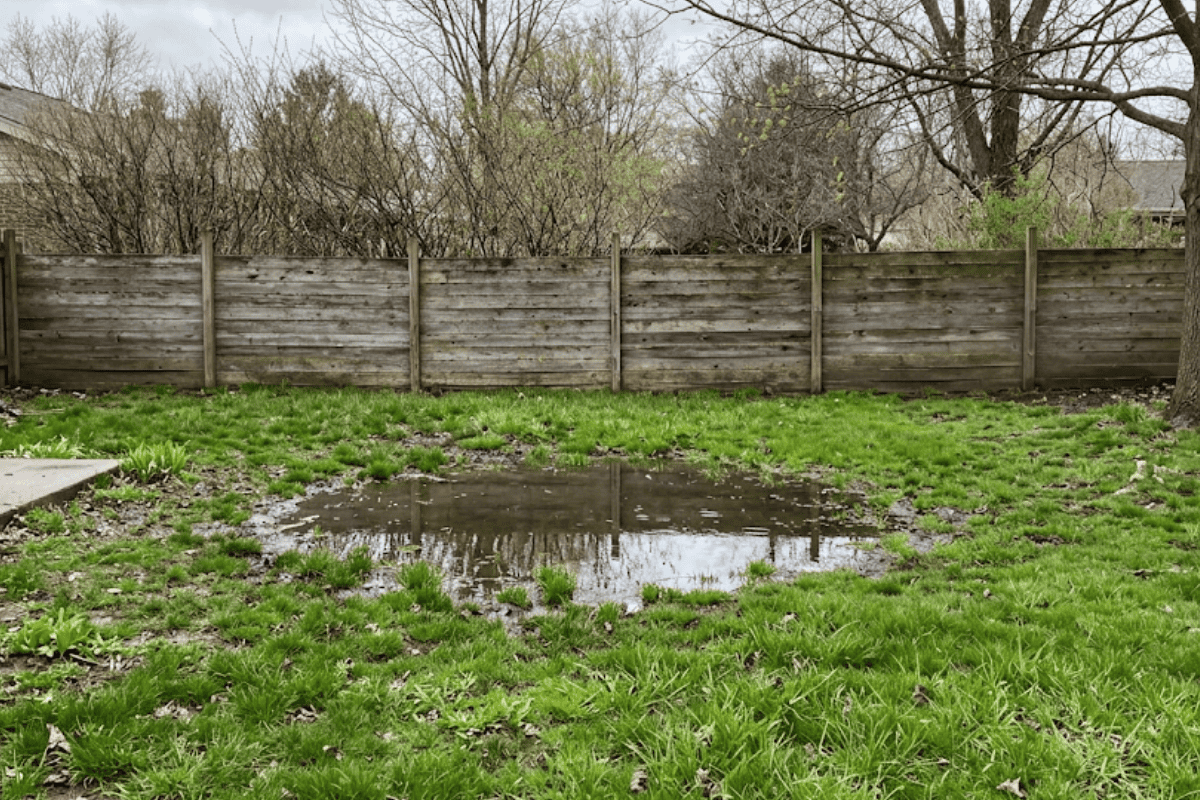
If a puddle in your backyard is still sitting there 48 hours after the rain stopped, that is not normal drainage, it is a warning sign. In Broken Arrow and across the Tulsa metro, heavy clay soil holds water instead of letting it soak in, and a low spot that never dries out is usually the first clue that a French drain is due. This guide walks through the signs you need a french drain in your yard, what causes them, and what it typically takes to fix the problem for good.
A French drain is a trench filled with gravel and a perforated pipe that collects water and redirects it away from your yard, foundation, or hardscape. It is not the only fix for a wet yard, but for the kind of standing water and soggy turf that Tulsa-area homeowners deal with after a spring storm, it is usually the most reliable one. Below are the signs to watch for, what is actually going on underground, and how to tell whether you are looking at a quick fix or a bigger drainage project.
Standing Water That Won’t Go Away
The clearest sign is water that pools in the same spot every time it rains and takes a day or more to disappear. In well-draining soil, water should soak in within a few hours. When it sits overnight, or through a second round of rain, the ground underneath is too saturated or too compacted to absorb it. This is especially common in low-lying areas of a yard, near the base of a slope, or in spots where two sections of lawn meet at slightly different grades.
Tulsa and Broken Arrow sit on soil that leans heavily toward clay, and clay particles pack together tightly enough that water has almost nowhere to go once the top few inches are saturated. That is different from sandy soil, which drains fast, or loam, which drains at a moderate rate. If you already know your yard tends toward heavy, sticky clay soils, standing water is less a surprise and more a matter of time.
Soggy, Spongy Turf in the Same Spots Every Season
A lawn that squishes underfoot in the same two or three areas, season after season, is telling you the same thing as standing water, just less obviously. Grass roots need oxygen, and saturated soil pushes air out of the root zone. Over time this shows up as thinning grass, slower regrowth after mowing, or bare patches that never quite fill back in no matter how much you reseed. If you have already tried aerating or top-dressing those spots and they still turn to mud every spring, the issue is underground, not on the surface.
Water Pooling Near the Foundation
This is the sign that turns a landscaping annoyance into a structural one. When water collects against a foundation wall instead of running away from the house, it puts constant pressure on that wall and can work its way into a crawl space or basement over time. Mold growth indoors is almost always a moisture problem first, and a foundation that stays damp after every rain is a common source. If you notice a musty smell near an exterior wall, or see mineral staining low on the foundation, that is worth addressing before it becomes a repair bill instead of a landscaping project.
Erosion Channels and Washed-Out Mulch
When a yard cannot absorb water fast enough, the excess starts moving across the surface instead of down into the soil, carrying polluted runoff along with it toward storm drains and nearby waterways. Over a few storms, that runoff carves shallow channels through mulch beds, washes soil away from the base of plants, and can undercut the edges of a patio or walkway. If you are constantly replacing mulch after every heavy rain, or you have noticed a visible groove forming across a slope, that is surface erosion doing the job that a properly graded French drain should be doing underground.
Water Runoff From a Neighboring or Uphill Property
Not every drainage problem starts on your own lot. If your property sits at the bottom of a slope, or downhill from a neighbor’s yard, you may be catching water that has nowhere else to go once it reaches your fence line. This is one of the trickier signs to diagnose because the wet spot in your yard might be nowhere near where the water is actually entering your property. A drainage assessment that traces the water’s path, not just the puddle, usually finds the real entry point.
What a French Drain Actually Fixes
A properly installed French drain design uses a sloped trench, a perforated pipe, and layers of gravel wrapped in filter fabric to intercept water before it pools and carry it to a safe discharge point, whether that is a storm drain, a dry well, or a lower part of the property. Getting the trench right starts with understanding the soil texture underneath it, since dense clay drains differently than the sandier soil found in a few pockets around Broken Arrow, and the gravel bed has to be sized accordingly. This is also where a dedicated French and storm drain system comes in for yards with heavier runoff, since storm drains handle high-volume flow that a standard French drain isn’t built for. The trench needs to be sloped correctly and sized for the volume of water it is expected to handle, which is why a DIY drain that is too shallow or too flat often stops working within a season or two.
| Sign in Your Yard | What’s Happening Underground | Typical Fix |
|---|---|---|
| Standing water 24+ hours after rain | Saturated or compacted clay soil, poor grading | French drain with proper slope and discharge point |
| Soggy turf in the same spots | Waterlogged root zone limiting oxygen | French drain plus aeration or regrading |
| Water pooling near the foundation | Grade sloping toward the house instead of away | Perimeter French drain and downspout extensions |
| Erosion channels in mulch beds | Surface runoff moving faster than soil can absorb it | French drain intercept trench on the slope |
| Runoff from a neighboring property | Uphill water entering at the property line | Catch basin plus French drain along the low side |
If your Tulsa yard turns into standing water after every storm, not just in one problem spot, it may be worth reading our related post on why yards flood for the bigger-picture causes before narrowing in on a French drain as the fix.
Signs You Need a French Drain Show Up Differently in Every Yard
Two properties on the same street can have completely different drainage problems depending on grading, tree cover, and where the roofline sheds water. A ranch home with gutters that dump straight onto the lawn will show different symptoms than a sloped lot backing up to a neighbor’s yard. That is part of why a walkthrough of the property, not a generic checklist, matters before anyone starts digging.
Why Choose Elite Outdoor Landscaping
Standing water in a Broken Arrow yard almost always traces back to Tulsa’s clay-heavy soil combined with the property’s specific grading, and that combination is different on every lot we walk. Instead of installing a drain wherever the puddle happens to be, we trace the water’s path back to where it is entering the problem area, which is often several feet from where it is pooling. That distinction matters because a drain placed at the visible wet spot instead of the actual low point in the grade will underperform no matter how well it is built.
We also size the trench and pipe to the water volume a Tulsa storm actually produces, not a one-size-fits-all spec, since a drain that is too shallow for a heavy spring rain will simply back up and leave you with the same puddle you started with. And because French drains tie directly into a yard’s broader grading and hardscape, we look at how the fix interacts with existing patios, retaining walls, and planting beds so the solution does not create a new problem somewhere else on the property.
Conclusion
The most important thing to take away here is that standing water in the same spot after every rain is not a lawn care issue, it is a drainage issue, and the two require different fixes. Aerating, reseeding, or adding topsoil will not solve a problem that starts with where the water is going, or not going, underground. If you are seeing two or more of the signs above in your Broken Arrow yard, the next step is a walkthrough to trace the water’s actual path rather than guessing at a fix based on where the puddle sits.
Ready to stop the standing water for good? Contact Elite Outdoor Landscaping for a drainage assessment.
Frequently Asked Questions
How do I know if I need a French drain or just better grading?
If water pools in a low spot but the rest of the yard sheds water fine, regrading that one area may be enough. If water is coming from a slope, a neighboring property, or saturated clay soil across a larger area, a French drain is usually needed because grading alone cannot move water fast enough during heavy rain.
How long does a French drain last?
A properly installed French drain with the right pipe, gravel, and filter fabric typically lasts 30 to 40 years with minimal maintenance. Drains that fail early are usually undersized, poorly sloped, or missing the filter fabric that keeps silt from clogging the pipe over time.
Can I install a French drain myself?
It is possible for a small, simple drain, but getting the slope, depth, and discharge point right is where most DIY drains go wrong. A trench that is too flat won’t move water, and one that discharges onto a neighbor’s property or into a low spot that has nowhere to go can create a new problem instead of solving the original one.
Will a French drain fix a wet basement?
It can help significantly if the water is coming from surface runoff or a saturated yard around the foundation. If the water intrusion is coming from a high water table or a structural issue with the foundation itself, a French drain around the perimeter is part of the solution but may need to be paired with interior waterproofing.
How much does a French drain cost to install?
Cost depends heavily on the length of the trench, depth required, and where the water needs to discharge. A short, simple drain runs less than a longer system that has to navigate around existing landscaping or tie into a storm drain. A site walkthrough is the only reliable way to get an accurate number for a specific yard.

Sorry, the comment form is closed at this time.