

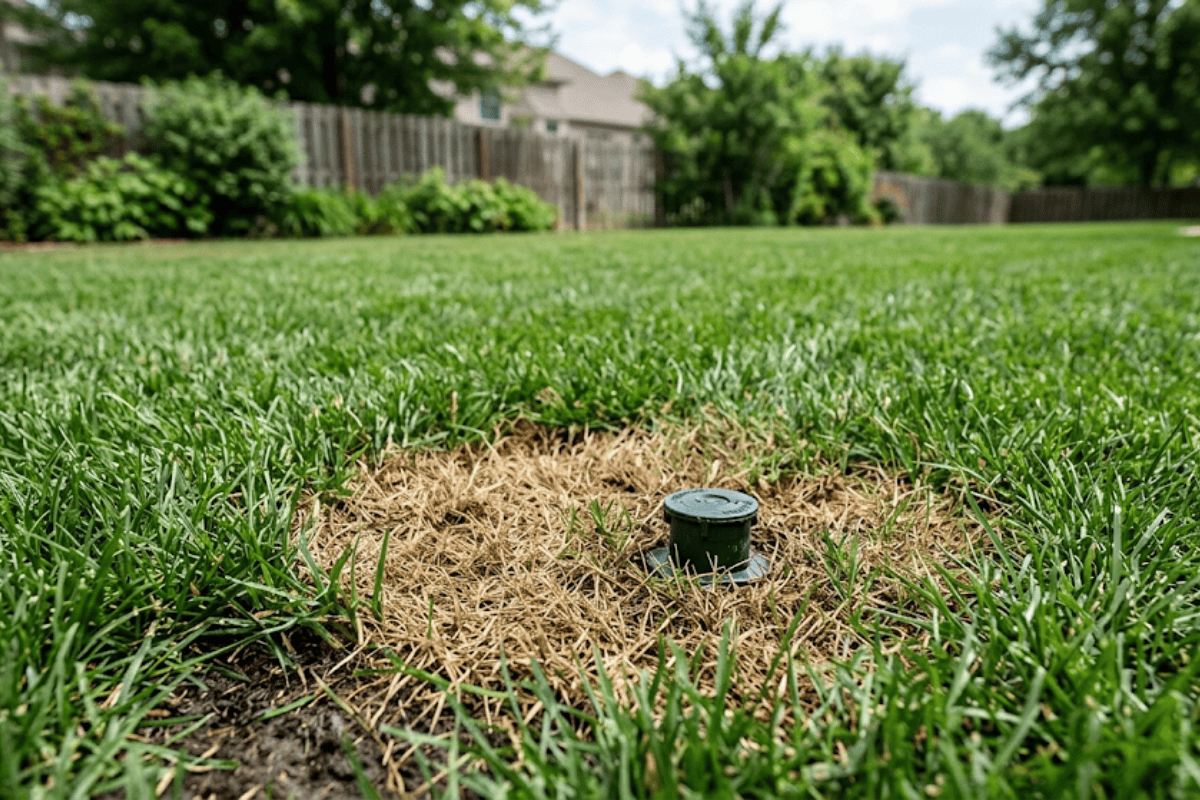
14 Sep Brown Spots in Lawn Even With Sprinkler System: What’s Really Going On
Brown Spots in Lawn With Sprinklers in Tulsa, OK
Running a sprinkler system on a set daily schedule does not guarantee even coverage, and shallow, frequent watering is one of the most common reasons Tulsa-area lawns develop brown spots even though the system is running exactly as programmed. Homeowners often assume that if the sprinklers are turning on, the lawn is being watered correctly, but coverage gaps, pressure problems, soil compaction, and fungal disease can all produce brown spots in lawn even with sprinkler system operation working as intended on paper. The fix almost always starts with figuring out which of these is actually happening in your yard.
Why “the Sprinklers Are On” Doesn’t Mean the Lawn Is Watered Evenly
A sprinkler system is only as good as its coverage pattern, and even a well-designed system loses uniformity over time as heads shift, nozzles clog, or pressure drops in one zone. According to Oklahoma State University Extension’s watering tips, lawns should be watered according to actual weather conditions and soil needs rather than a fixed calendar schedule, since overcast days, humidity, and recent rain all change how much water the grass actually needs. A system running on autopilot without seasonal adjustment often overwaters some zones while quietly underwatering others.
The most reliable way to check your own system’s coverage is a simple catch-cup test, sometimes called an irrigation audit. Placing several shallow cups across a zone and running the system for a set time shows exactly how much water each spot receives, and it frequently reveals a 30 to 50 percent difference in output between cups in the same zone. That gap is almost always where brown spots start to show up first.
The Most Common Causes, Side by Side
The table below breaks down the sprinkler-related causes that show up most often in Tulsa-area lawns, along with what each one typically looks like and how it gets fixed.
| Cause | What It Looks Like | Fix |
|---|---|---|
| Uneven head coverage | Brown rings or dry wedges between heads | Adjust spray pattern or add a head to close the gap |
| Low pressure in one zone | One zone stays dull while others stay green | Check for a partially closed valve or a leak |
| Compacted soil under the turf | Water pools, then runs off before soaking in | Core aerate before the next irrigation cycle |
| Brown patch fungus in hot, humid weather | Roughly circular patches up to three feet across | Adjust watering timing, apply fungicide if needed |
| Clogged or tilted sprinkler head | Same dry patch reappears in the same spot every week | Clean, replace, or re-level the head |
Still Seeing Brown Patches Every Summer? Contact Elite Outdoor Services for a Free Irrigation Evaluation
Brown Patch Fungus vs. Watering Problems
It is worth separating disease from irrigation early, because the fix is completely different. Brown patch fungus tends to show up during hot, humid stretches and produces patches up to three feet across, according to Oklahoma State University Extension’s coverage of brown patch disease, which most commonly affects cool-season grasses like tall fescue during Oklahoma’s humid summer nights. A brown spot caused by fungus usually has a slightly darker, water-soaked ring around the edge, while a brown spot caused by uneven coverage tends to have a clean, gradual fade from green to brown as you move away from the nearest sprinkler head.
Timing matters just as much as volume. The smart watering guidance from the EPA’s WaterSense program recommends watering early in the day rather than in the evening, since overnight moisture sitting on the blades is exactly the condition that encourages fungal growth. A schedule that waters at 9 p.m. every night, even if the total volume is correct, can quietly be setting the lawn up for the brown patch problem it is trying to prevent.
A Few Things to Check Before Calling Anyone
- Run each zone manually and watch for heads that don’t pop up fully or spray in the wrong direction
- Check water pressure at an outdoor spigot near a weak zone to rule out a supply-side issue
- Look for a pattern: spots in the same location every week point to equipment, while spots that move around point to fungus or soil
- Confirm the controller’s seasonal adjustment, sometimes called a water budget setting, hasn’t been left on a summer setting into a cooler month
- Note whether the irrigation system was professionally designed for the yard’s actual square footage, since undersized systems often can’t cover corner areas evenly
Once you’ve ruled out the obvious equipment issues, working with certified irrigation professionals for a full system audit is usually faster than continuing to troubleshoot zone by zone on your own, especially if the brown spots have been recurring for more than one season. A zone that never got a clean winterizing the previous fall can also start the season with trapped air or a valve that never fully reopened, which shows up months later as exactly this kind of stubborn brown patch.
Why Choose Elite Outdoor Services
Diagnosing brown spots starts with a zone-by-zone coverage check, not a blanket recommendation to water more. Every irrigation evaluation includes testing actual output at multiple points in each zone, since a system that looks fine from the controller can still be leaving entire sections of turf underwatered. Tulsa-area lawns are a mix of fescue, bermuda, and zoysia, and each one has a different tolerance for the kind of uneven watering that causes brown patches, so the fix is built around the grass type actually growing in the yard rather than a generic watering schedule applied to every property the same way.
Conclusion
Brown spots in lawn even with sprinkler system use are a coverage and timing problem far more often than they’re a “not enough water” problem. Running a catch-cup test, checking for pressure differences between zones, and separating fungal disease from irrigation gaps will point you toward the actual cause instead of just increasing the watering schedule and hoping it helps. For most Tulsa yards, a properly audited and adjusted system solves the issue without wasting additional water on zones that were never the problem in the first place.
Ready for an Even, Green Lawn? Schedule a Free Estimate With Elite Outdoor Services
Frequently Asked Questions
Why does my lawn have brown spots even though I water it every day?
Daily watering often causes shallow root growth and uneven coverage rather than solving the problem, since grass watered lightly every day never develops the deep roots needed to handle heat stress. Brown spots frequently persist or worsen under a daily schedule because the underlying coverage gap or soil compaction is never addressed.
How do I fix brown spots in my lawn from a sprinkler system?
Start with a catch-cup test to measure actual water output across the affected zone, then check for clogged, tilted, or misaligned heads in that area. In most cases, adjusting or replacing the affected heads and correcting the watering schedule resolves the spot within two to three weeks.
Can overwatering cause brown spots in a lawn?
Yes, overwatering can suffocate roots and create the damp, humid conditions that encourage brown patch fungus, which produces its own distinct brown spotting pattern. It can also wash away nutrients faster than the grass can absorb them, weakening the turf in ways that show up as thinning or discoloration.
How long does it take for brown spots in grass to recover?
Once the underlying cause is corrected, most brown spots caused by uneven watering or minor equipment issues begin recovering within two to three weeks during the growing season. Spots caused by fungal disease may take longer and can require a fungicide application before new growth fills back in.
Should I water my lawn every day if it has brown spots?
No, daily shallow watering is one of the more common mistakes that causes brown spots in the first place. Deeper, less frequent watering that reaches the root zone is generally more effective and is the approach recommended by university extension guidance for most turf types in Oklahoma.

Sorry, the comment form is closed at this time.