

07 Sep Neighbor’s Water Drains Into My Yard: What Can I Do?
Neighbor Water Draining Into Your Yard in Tulsa, OK
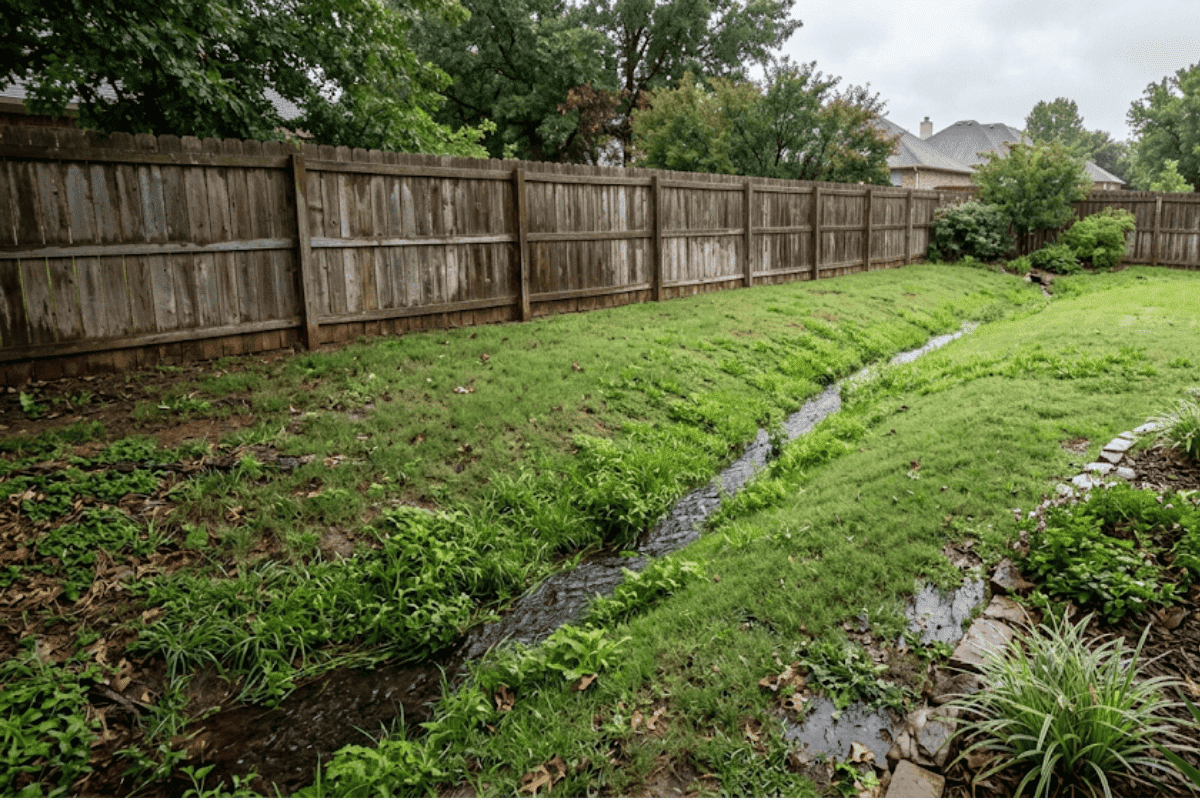
After a two-inch rain in Broken Arrow, water pooling three feet from a fence line is usually runoff crossing over from a neighboring lot, not a plumbing problem. It is one of the most common drainage complaints homeowners bring up across the Tulsa metro, and it almost always comes down to grading: water follows the lowest path available, and if your yard sits lower than the one next door, you are on the receiving end of every storm that rolls through. Understanding why a neighbor’s water drains into your yard is the first step toward a fix that actually holds up season after season.
Why This Happens in the First Place
Oklahoma’s mix of heavy clay soil and rolling terrain makes cross-property drainage a routine issue, not a rare one. Clay does not absorb water quickly, so once a storm saturates the ground, extra water has nowhere to go but downhill, across property lines, and into whatever yard sits at the lower elevation. A fence, a shed, or even the natural slope of a driveway can redirect that flow and concentrate it in one low spot instead of letting it spread out. According to Oklahoma State University Extension’s guidance on urban drainage, drainage problems in residential landscapes are typically tied to a combination of hydrology, soil type, grading, and slope working against each other at once.
Legally, most states, including Oklahoma, have moved toward what is known as the reasonable use rule for surface water. A detailed breakdown of that shift is available in this surface water law review, which traces how courts evaluate whether a neighbor’s grading or landscaping changes unreasonably increased the water reaching an adjoining property. In practice, natural runoff following the original slope of the land is usually considered normal, while a neighbor actively regrading, piping, or concentrating water onto your lot is a different situation and may warrant a conversation, or in persistent cases, a call to your city’s stormwater department.
How to Confirm Where the Water Is Actually Coming From
Before assuming a neighbor is the source, walk your property line during or right after a heavy rain and watch where the water is moving. A few things to check:
- Whether water is sheeting evenly across the property line or funneling through one specific low point
- Whether downspouts, a sloped driveway, or a patio on the neighboring lot are directing water toward your yard
- Whether standing water lasts more than 24 hours after rain stops, which usually signals compacted soil rather than simple overflow
- Whether the water pools within 10 feet of your own foundation, which raises the priority level considerably
- Whether the issue only shows up after specific storms, which can point to a gutter or grading change rather than a chronic slope problem
Once you know the source and the path the water takes, the right fix becomes much clearer, and you avoid paying for a solution that treats the wrong symptom. If the water is pooling rather than draining, a professional drainage evaluation can pinpoint the exact low point and the volume of water it needs to handle before any digging starts.
Common Drainage Problems and the Right Fix
The table below lays out the most frequent versions of this problem across Tulsa-area yards and the fix that typically resolves each one.
| Problem | What Causes It | Typical Fix |
|---|---|---|
| Water sheeting off a neighbor’s higher lot | Grade slopes toward the property line | Swale or French drain along the property line |
| Standing water 24+ hours after rain | Compacted clay soil with poor percolation | Regrading, French drain, or a dry well |
| Water pooling near the foundation | Negative grade within 10 feet of the house | Foundation regrading, French drain, downspout extensions |
| Soggy spot in the middle of the yard | Low point with no natural outlet | Catch basin tied to a French drain line |
| Erosion along a fence line | Concentrated runoff with no dispersal point | Rock channel or buried drain pipe |
Every one of these fixes is designed to intercept water before it reaches the problem area and carry it somewhere it can drain safely, whether that is a storm sewer, a dry well, or a lower point on your own property that can handle the volume.
Ready to Stop Guessing at the Fix? Contact Elite Outdoor Services for a Free Drainage Consultation
Grading, French Drains, and Dry Wells: Matching the Fix to the Yard
Not every drainage problem needs the same solution, and installing the wrong one is a common reason homeowners end up paying twice. A shallow swale, essentially a gentle, grass-lined channel, works well when water just needs to be redirected across open ground toward a lower point. A French drain, a buried perforated pipe wrapped in gravel and fabric, is the better choice when water needs to be captured below the surface and carried somewhere specific, such as a storm drain tie-in or a daylight outlet at the edge of the property. If neither has anywhere to drain to, a dry well, essentially an underground reservoir that lets water slowly percolate into the surrounding soil, can solve a landlocked low spot.
The runoff control standard from the USDA NRCS outlines the same layered approach used by contractors nationwide: reduce the volume reaching a problem area first, then manage what is left with grading or piping. A properly installed French drain needs the correct slope, pipe size, and outlet location or it will simply back up again during the next heavy storm.
Site grading is the piece homeowners skip most often, and it is usually the piece that matters most. The site grading guidance from the Building America Solution Center recommends maintaining a consistent slope away from structures before any drainage feature is added, since a drain installed against the existing grade will fight the slope of the land indefinitely.
What This Looks Like Across a Broken Arrow Summer
Oklahoma’s storm pattern makes this a recurring issue rather than a one-time fix. According to Tulsa rainfall records kept by the National Weather Service, the Tulsa area regularly sees intense, short-duration storms that can drop a significant amount of rain in under an hour, which is exactly the kind of event that overwhelms a yard with inadequate grading. A drainage system sized for a light, steady rain often fails during one of these bursts, which is why an assessment needs to account for the area’s actual storm patterns, not just average rainfall.
Why Choose Elite Outdoor Services
Every drainage assessment starts at the low point in the yard, not with a generic quote pulled together from a phone call. Walking the property during or right after a rain event shows exactly where water enters, where it concentrates, and where it needs to exit, which is the only reliable way to size a French drain or grading plan correctly the first time. Broken Arrow, Bixby, Jenks, and Owasso share the same dense clay base, so a fix that works on one street typically needs adjustment for the next yard over, depending on how the original grading was done when the home was built. Rather than defaulting to the same drain on every job, the approach is matched to what the soil, slope, and neighboring runoff are actually doing on that specific property.
Conclusion
A neighbor’s water draining into your yard is rarely about bad intentions. It is almost always about grade, soil, and where water naturally wants to go once it hits the ground. Confirming the source, understanding whether the flow is a normal slope pattern or an unreasonable diversion, and matching the fix, whether that is a swale, a French drain, or a dry well, to the actual problem will stop the cycle of standing water and repeated erosion. For most Tulsa-area yards, that means combining proper grading with a drainage line sized for the area’s heavy, fast-moving storms.
Dealing With Standing Water After Every Storm? Get a Free Estimate From Elite Outdoor Services
Frequently Asked Questions
Is my neighbor legally responsible for water draining onto my property?
It depends on whether the water is following its natural, pre-existing slope or being actively redirected by grading, piping, or new construction on the neighboring property. Most states, including Oklahoma, apply a reasonable use standard, meaning natural runoff following the original slope is typically not actionable, while an artificial diversion that increases the water reaching your yard may be.
Can I legally block water from flowing onto my property?
You generally cannot simply dam or wall off natural drainage in a way that pushes the problem back onto your neighbor’s property, since that can create its own liability. The safer approach is to manage the water once it reaches your yard using grading, a swale, or a French drain that carries it to an appropriate outlet.
How do I stop water from draining into my yard from a neighbor’s yard?
Start by confirming exactly where the water enters and how it moves once it is there. In most cases, a swale or French drain installed along the property line, combined with grading that directs the water toward a safe outlet, resolves the problem without needing to involve the neighbor directly.
Who is responsible for maintaining a drainage easement between properties?
This varies by city and by the specific easement language on file with the county, so it is worth checking your property’s plat map or contacting your municipality’s stormwater department if a formal drainage easement is involved. In the absence of a recorded easement, each property owner is generally responsible for managing water once it reaches their own land.
How much rain does it take to cause yard flooding in Oklahoma?
It varies by soil type and existing grading, but Oklahoma’s storms are often short and intense rather than slow and steady, which means a yard with poor drainage can flood from a single heavy downpour even if the monthly rainfall total looks unremarkable. Yards with compacted clay soil are especially prone to standing water after these fast-moving storms.

Sorry, the comment form is closed at this time.