

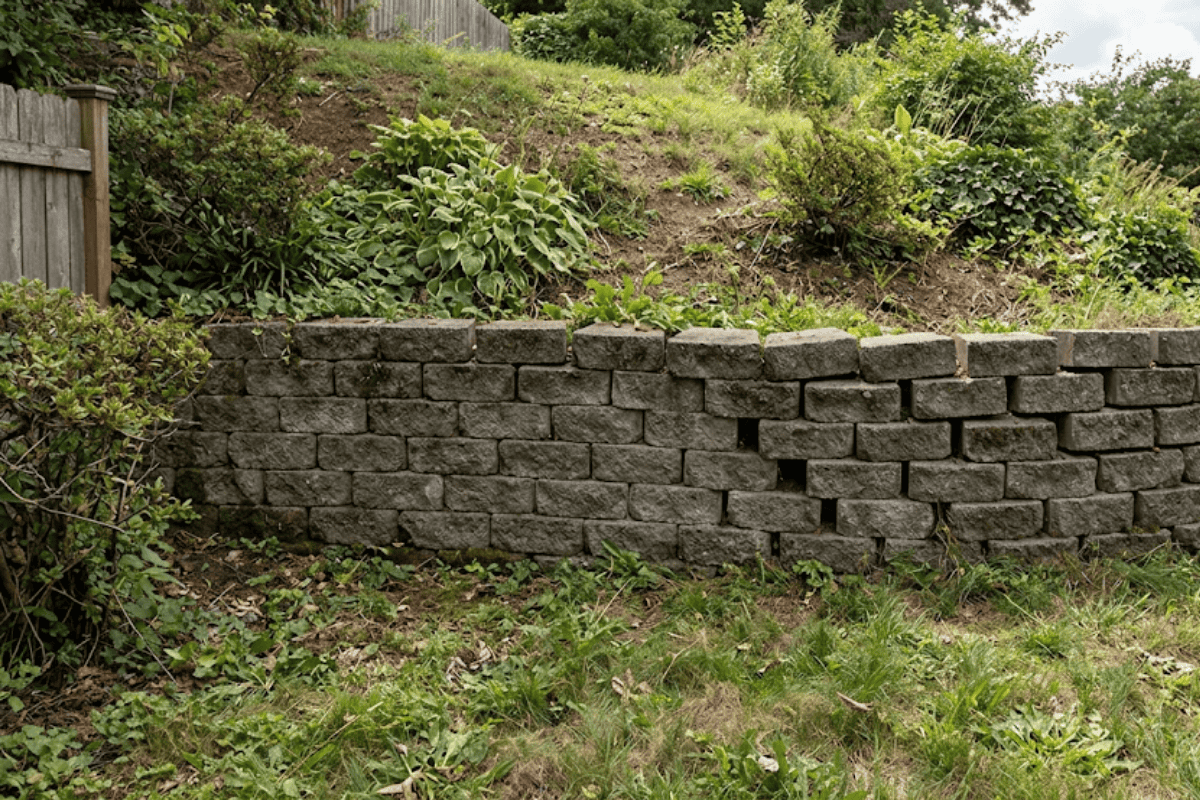
21 Aug Why Is My Retaining Wall Leaning? What Should I Do?
Most homeowners never measure the lean on a retaining wall until something looks obviously wrong, but there is an actual number that separates a wall that is fine from one that is failing: about 1 inch of lean for every foot of wall height. Below that, a slight backward tilt is often intentional, a design element called batter that helps the wall resist pressure. Above that, the wall is likely losing its structural fight against the soil and water behind it, and waiting to see what happens next is the wrong move.
If you are standing in your Broken Arrow yard right now looking at a wall that seems to be tipping more than it used to, this guide walks through why is my retaining wall leaning, what should I do about it, and how to tell the difference between a cosmetic issue and one that needs attention soon.
The Most Common Cause: Water Pressure Behind the Wall
Inadequate drainage behind a retaining wall causes the majority of leaning wall problems, and the mechanism is straightforward once you understand it. Soil behind a wall is supposed to stay relatively dry, with water routed away through gravel backfill and a drainage pipe. When that drainage is missing, undersized, or clogged, rainwater saturates the soil instead of draining through it, and saturated soil is dramatically heavier and pushes with far more lateral force than dry soil. Water weighs about 62.4 pounds per cubic foot on its own, and once soil is saturated, the combined pressure against a wall can run two to three times higher than what a dry-soil design accounts for.
This is exactly why poor drainage is consistently identified as the leading cause of retaining wall performance problems, not the wall material itself. A block wall with excellent drainage will outperform a more expensive stone wall with none.
Poor Soil Compaction Beneath the Wall
The second major cause is what is happening under the wall rather than behind it. If the base wasn’t compacted properly before construction, the wall settles unevenly as the ground beneath it shifts over time, and the risk varies depending on local soil classification, since Oklahoma’s clay-heavy soils compact and settle differently than sandier ground. This kind of lean often shows up gradually and unevenly along the wall’s length, with one section tilting more than another, because the soil compaction issue is rarely uniform across the whole footprint. A wall built directly on undisturbed topsoil instead of a compacted gravel base is especially prone to this kind of settling.
Missing or Inadequate Structural Reinforcement
Taller walls, or walls holding back a steep slope, need more than gravity and a solid base. Geogrid reinforcement, tiebacks, or a properly engineered footing all help a wall resist the load behind it, and a wall built without adequate reinforcement for its height and the slope it is retaining is working harder than it was designed to. This is one of the reasons a wall over about 3 to 4 feet tall typically needs an engineered design rather than a standard build, since building codes generally require walls to be designed for full hydrostatic pressure unless a drainage system is in place, and engineering guides used across state transportation departments treat drainage detailing as a core part of any wall’s engineered footing and reinforcement plan. There are actually seven design factors that go into a properly engineered wall, and drainage runs through nearly all of them.
How to Tell If the Lean Is a Real Problem
| What You See | What It Likely Means | Urgency |
|---|---|---|
| Slight backward tilt, roughly 1 inch per foot of height | Often intentional batter, built into the design | Low — monitor over time |
| Lean greater than 1 inch per foot | Likely drainage failure or soil pressure exceeding the wall’s capacity | Moderate to high — schedule an assessment |
| Cracks running through blocks or mortar joints | Structural stress from shifting soil or water pressure | High — address before it worsens |
| Bulging in the middle of the wall | Hydrostatic pressure overwhelming the wall’s resistance | High — risk of partial or full failure |
| Standing water pooling at the base of the wall | Drainage system is clogged, undersized, or missing | Moderate — fix before it worsens the lean |
To check your own wall, measure the horizontal distance the top of the wall has shifted compared to the base, then divide by the wall’s height in feet. A result close to 1 inch per foot suggests intentional design. Anything meaningfully higher is worth a closer look, especially if it has changed noticeably over the past year.
What Should I Do If My Wall Is Leaning?
The right response depends on how far the lean has progressed. A wall with a mild, stable lean and no cracking can often be addressed by improving the drainage behind it, digging carefully to relieve some of the trapped water pressure, and adding or replacing gravel backfill and a drainage pipe so future rain does not recreate the problem. This is the least invasive fix and the one worth pursuing first when the wall’s overall structure still looks sound.
A wall with a more significant lean, visible cracking, or bulging usually needs a partial or full rebuild, because the underlying compaction or reinforcement issue that caused the movement will keep causing it until it is corrected at the source. Trying to patch a structurally compromised wall without addressing what is behind or beneath it typically buys a year or two before the same problem returns, often worse.
In either case, do not ignore vegetation growing directly against or through the wall. Root systems from dense shrubs or trees planted too close can exert their own pressure and interfere with drainage, and clearing that growth back is a simple step that is easy to overlook. The same kind of persistent growth is behind another common Tulsa hardscape complaint, covered in our post on weeds between pavers, if you’re dealing with both issues on the same property.
Why Choose Elite Outdoor Landscaping
A leaning wall in a Broken Arrow yard almost always traces back to how the drainage behind it was designed, or whether it was designed at all, so that is the first thing we assess rather than jumping straight to a rebuild. Digging into the actual cause, whether it is missing drainage, a compaction issue at the base, or reinforcement that was never adequate for the wall’s height, determines whether the fix is a drainage correction or a structural rebuild, and getting that diagnosis right up front saves you from paying for a repair that does not address the real problem.
We also look at how the wall interacts with the rest of the property’s hardscape design, since a retaining wall rarely fails in isolation from the grading and drainage around it. If the same water pressure that is pushing on the wall is also affecting a nearby patio or walkway, addressing just the wall without looking at the broader water flow across the property tends to leave the underlying issue unresolved.
Conclusion
The most important thing to take from all of this is that the 1-inch-per-foot rule of thumb gives you a real way to tell intentional design from a genuine problem, so measure before you assume the worst or dismiss what you are seeing. If your wall’s lean is beyond that threshold, or you’re seeing cracking, bulging, or water pooling at the base, the underlying cause is almost always drainage or compaction, and both get worse the longer they go unaddressed. Getting an assessment in Broken Arrow, Oklahoma sooner rather than later is what keeps a fixable drainage issue from turning into a full rebuild.
Not sure if your wall’s lean is normal or a warning sign? Contact Elite Outdoor Landscaping for an assessment.
Frequently Asked Questions
How much lean is normal for a retaining wall?
A lean of roughly 1 inch for every foot of wall height, tilting backward into the slope, is often an intentional design feature called batter that helps the wall resist pressure. A lean beyond that ratio suggests the wall is losing its structural resistance rather than being built that way on purpose.
Can a leaning retaining wall be fixed without rebuilding it?
Yes, if the lean is mild and there is no cracking or bulging, improving the drainage behind the wall and relieving trapped water pressure can often stabilize it without a full rebuild. More significant leaning, especially with visible cracks, usually means the wall’s structure has already been compromised and needs to be partially or fully rebuilt.
What causes a retaining wall to fail?
The two most common causes are inadequate drainage, which lets water pressure build up behind the wall, and poor soil compaction beneath the wall’s footing, which causes uneven settling over time. Walls that are too tall for their design, or missing reinforcement like geogrid, are also more prone to failure.
How urgent is a leaning retaining wall?
It depends on the severity. A wall with a stable, minor lean and no other symptoms can often be monitored, but visible cracking, bulging, or a lean that has clearly worsened over recent months should be assessed soon, since these walls can fail with little additional warning.
Will drainage fixes stop a wall from leaning further?
In many cases, yes, since inadequate drainage is the leading cause of the water pressure that pushes walls out of position. If the wall has already lost significant structural integrity from prolonged pressure or poor compaction, drainage improvements alone may not be enough to correct the lean that has already occurred.

Sorry, the comment form is closed at this time.